|
How M/S Stereo Works
Usually the most intuitive way to perform a task is the best ... but not always.
Similarly, when placing microphones to record a stereo
signal the most intuitive way to go about it is what's known as A-B mic'ing. Two
mics are placed some distance apart and pointed in the direction of the source
to be recorded. The mic on the left is recorded as the L channel and the one on
right as R. On the face of it this looks pretty fool-proof and when you listen
to a ping pong game recorded this way, sure enough - it sounds like stereo. On playback, there can be listener positions where delays from the speakers interact with the recorded delay to produce comb-filter effects. In other words, the timbre may change depending on the listener's location. There may be several randomly located "sweet spot" locations in a room where everything sounds great and other places where bass is weak and others where it's overbearing and other places where high end and mid range are problems. Also, when an A-B mic'd stereo signal is converted to mono - like when heard on most AM radios - some notes, even whole instruments, can go away because of phase cancellation of recording articfacts. There are alternatives to A-B Mic'ing that prevent these
problems, MS recording for instance. MS is an acronym for Mid-Side, named for
the two signals that encode the location of sound sources and reverbrant
ambiance of the stereo image. MS Stereo principles are used in the broadcast
delivery of Mono/Stereo compatible sound and as part of Surround system but it
is how these principles apply to microphone selection and placement during
recording that is of concern here. The Mid signal comes from a mic with a Cardioid polar sensitivity oriented so that the "front" faces the center of the stage. This signal is essentially a mono mix of the Right and Left sides of the stereo field and encodes very little information on placement of sound sources. For example, if the source "A" in the illustration is moved from the Right side of the stage to the equivalent position on the Left, the Mid signal will not change significantly. Mathematically the Mid signal can be expressed as R+L.
FM Stereo, Stereo TV and even some quad and surround sound
systems use MS encoded signals because it is an easy path to sending a signal
that is mono/stereo compatible. In these systems, the Mid signal modulates the
main sound carrier while the Side signal modulates a stereo subcarrier. In
simple monophonic receiving equipment only the main carrier is demodulated and
the Mid signal is used for a mono output. When stereo outputs are desired, the
stereo subcarrier is also demodulated and the Side signal combined with the Mid
signal in a decoder to extract Left and Right Stereo channels.
|
 Since we have Left and
Right ears, the most intuitive way to encode stereo sound information is as Left
and Right channels. And stereo delivery media such as CD, tape, vinyl and older
film do it just this way.
Since we have Left and
Right ears, the most intuitive way to encode stereo sound information is as Left
and Right channels. And stereo delivery media such as CD, tape, vinyl and older
film do it just this way.
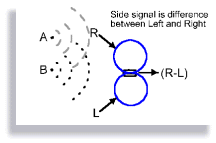 The Side signal comes from a mic with a Figure
8 polar sensitivity oriented so the lobes are facing Right and Left. Two
characteristics of this map are important. First, the mic is deaf to sound
sources located between the two lobes; for example, source "B" in the
illustration will not be present in the Side signal at all. Also, there is a
phase inversion between the Right and Left lobes - if source "A" is
moved from the Right side of the stage to the equivalent postion on the Left,
its relative phase will be inverted in the output. Math shorthand for this is
R-L.
The Side signal comes from a mic with a Figure
8 polar sensitivity oriented so the lobes are facing Right and Left. Two
characteristics of this map are important. First, the mic is deaf to sound
sources located between the two lobes; for example, source "B" in the
illustration will not be present in the Side signal at all. Also, there is a
phase inversion between the Right and Left lobes - if source "A" is
moved from the Right side of the stage to the equivalent postion on the Left,
its relative phase will be inverted in the output. Math shorthand for this is
R-L. The MS Decoder performs sum and difference
operations to extract Right and Left level and phase information from the Mid
and Side signals. In the illustration the circles with "+" signs
represent summing functions. The triangle represents a 180º phase inversion,
the equivalent of changing the sign of the output relative to the input or
multiplying the input by -1.
The MS Decoder performs sum and difference
operations to extract Right and Left level and phase information from the Mid
and Side signals. In the illustration the circles with "+" signs
represent summing functions. The triangle represents a 180º phase inversion,
the equivalent of changing the sign of the output relative to the input or
multiplying the input by -1.